How City Park Helps Reduce Traffic and Improve Daily Life in South Dade
For families in West Kendall, traffic is more than an inconvenience. It is a daily reality that affects work schedules, school drop-offs, family time, and overall quality of life. Long commutes and congested roads have become routine, with many residents spending hours each day driving across Miami-Dade County just to reach jobs, schools, dining, and entertainment.
It is understandable that people ask whether City Park will worsen traffic. But that question assumes traffic is caused solely by growth. According to traffic expert Tim Plummer, that assumption misses the real issue.
“Traffic in Miami-Dade isn’t driven by population alone,” Plummer explains. “It’s driven by how far people are forced to travel every day to reach work, schools, and basic services.”
City Park was designed specifically to address that root problem.
Why Traffic Is So Challenging in West Kendall Today
West Kendall has grown primarily as a residential area without the nearby employment centers, entertainment, and services needed to support it. As a result, tens of thousands of residents travel long distances every morning and evening, creating congestion during peak hours and placing constant pressure on local roads.
“For years, West Kendall and South Dade have lacked major job and entertainment centers,” says Plummer, who has spent more than 35 years studying traffic patterns and development across Miami-Dade County. “That forces residents to commute long distances across the county for work or even a night out.”
The issue is not that too many people are living in the area. It is that daily life requires too much driving.
A Community Designed to Reduce Long Commutes
City Park is planned as a true 15-minute community, where daily needs are within a short walk, bike ride, or local trip.
“With mixed-use development, you bring balance back to a community,” Plummer explains. “When jobs, housing, and daily needs are closer together, people simply don’t need to drive as much.”
With more than 36,000+ jobs projected for City Park, many residents will be able to work closer to home rather than commute across Miami-Dade County.
Jobs Close to Home Are Central to Traffic Relief
“After decades of planning mistakes in Miami-Dade, we now know that balanced, mixed-use communities are one of the most effective ways to reduce traffic,” Plummer says.
Designed to Give Families Transportation Choices
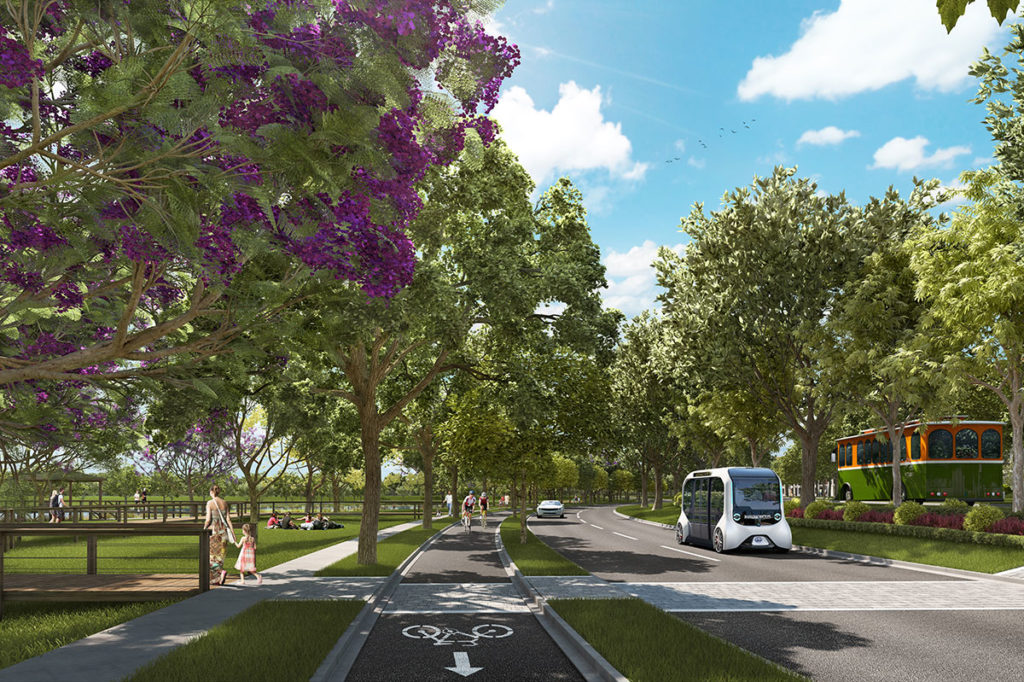
City Park is designed around mobility, not car dependency.
“City Park improves mobility by giving people real choices,” Plummer notes. “Walking, biking, transit, and driving all work together when a community is designed correctly.”
Preventing Future Traffic Problems
“When communities don’t provide nearby jobs and services, growth pushes farther west,” Plummer explains. “That leads to longer commutes and more congestion over time.”
Separating Myth From Fact
“There’s a lot of misinformation out there,” Plummer says. “The reality is that balanced, mixed-use communities like City Park are one of the most proven ways to reduce traffic by as much as 50 percent, not increase it.”
A clear example is Babcock Ranch in Southwest Florida, a large-scale mixed-use community that has been under development for more than 15 years. As the community has built out across its residential, commercial, and school components, annual traffic monitoring has tracked real-world conditions. Actual traffic counts taken in 2024 show vehicle trips were reduced by approximately 60 percent compared to the original estimated traffic projections.
Less Time Driving. More Time Living.
City Park was designed to give West Kendall families the ability to live, work, learn, and enjoy life closer to home. That means fewer cars on the road, shorter commutes, and a better quality of life for the entire region.